Lately I’ve had spring on the brain despite the weather reports of chilly temperatures. In hopes of making my wishful thinking a reality, I decided to make a spring-themed project to usher in the season. One day while I was browsing the cyber universe, I saw these adorable gloves on Japanese blog with bunnies on them! “How perfect is this”, I thought. “Nothing says spring like bunnies!”
(more…)
Posted in Knitting, Tips & How To | 2 Comments » Comments
Technical editor and yarncrafting expert Kj Hay returns to share her expertise on starting your knitting project on the right foot. Click here for the first half of this series or click here to check out Kj’s earlier blog posts on crochet.
Click on the images to see them as a slide-show; click the left and right arrows to navigate through the pictures. Click the X in the top-left corner to exit the slide-show. Please note that if you’re viewing this post in an RSS reader or an email, you will have to click the title to use the full functionality on our site.
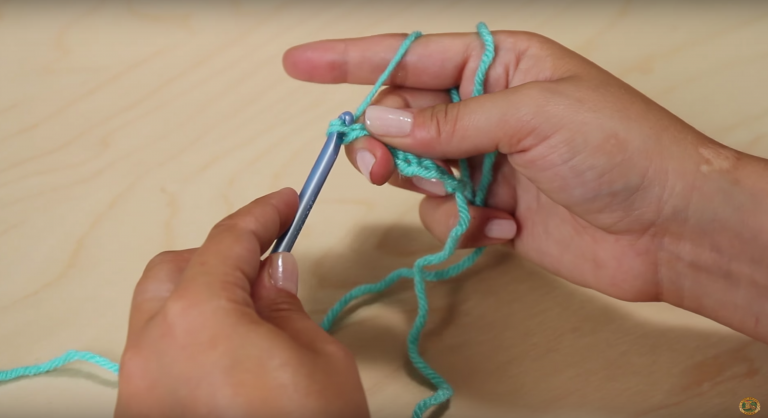
Work same as long-tail cast on method demonstrated earlier until needle and yarn are in the “sling shot” position. In the “sling shot” position, the yarn has been attached to the needle with a slip knot and the two strands have been wrapped around your index finger and thumb. The tail should travel from the slip knot, between your thumb and index finger, around the back of your thumb and down into your palm. Similarly, the working yarn should travel from the slip knot, between your index finger and thumb, around the back of your index finger and down into your palm.
Repeat this process until desired number of stitches have been cast on.
And this is just the beginning. There are many, many different cast on methods and many variations on the cast on methods you already know. You may enjoy listening to YarnCraft episode 129, for more information and inspiration. Click here for the episode guide to this podcast (an online radio show); use the player below to listen right now.
Audio clip: Adobe Flash Player (version 9 or above) is required to play this audio clip. Download the latest version here. You also need to have JavaScript enabled in your browser.
Posted in Knitting, Tips & How To, Tutorials | 4 Comments » Comments
Technical editor and yarncrafting expert Kj Hay returns to share her expertise on starting your knitting project on the right foot. Join us tomorrow for the second half of this series or click here to check out Kj’s earlier blog posts on crochet.
“Let’s start at the very beginning. A very good place to start.” — “Do-Re-Mi” from the Sound of Music.
When you read you begin with A-B-C. When you knit you begin with casting on. Thankfully to begin knitting, there is no need to learn every one of the huge number of cast on methods. It is wise to begin by learning one general cast on method, and forge ahead with your first few projects. After you have completed some projects about which you are deservedly proud, you may be in the mood to learn some new cast on methods.
Videos, illustrations and written instructions for a few of the most commonly used cast on methods are available in the Lion Brand Learning Center.
The last of these methods, long-tail cast on, is possibly the favorite method for beginners and experienced knitters alike. This method uses two strands of yarn; a long tail and the strand of working yarn connected to the ball. New stitches are made by drawing loops of the working yarn through loops from the long tail. In this way a foundation of loops and a row of stitches are formed at the same time. There are actual a number of different ways to work a long-tail cast on. The approaches differ in manner in which the strands, and needle(s) are manipulated and can produce slightly different results. The most common approach is demonstrated in this Lion Brand video:
A long-tail cast on requires more motions than many other methods, but with a little practice it can be performed very quickly and provides a good beginning edge for almost all knitted projects.
Posted in Knitting, Tips & How To | 5 Comments » Comments
Technical editor and yarncrafting expert Kj Hay joins us for several articles on starting your project right. This is the last of her 3-part series on crochet. Click here for yesterday’s article, and click here for the previous day’s article. Join us next week for a 2-part series on knitting.
Hats, bags, and toys often begin with a tight circle. Foundation chains can be used for this purpose and there are two common methods: 1) Work a short foundation chain (ch 2 for a circle of single crochet, ch 3 for half double crochet, ch 4 for double crochet, etc.) then work the stitches of first round into the first chain made, 2) Work a short foundation chain (but, longer than for first method), join the ends of the chain with a slip stitch to form a ring, then work the stitches of first round directly into the ring (not into the chains). Both of these methods can produce unacceptably large center holes that can be difficult to close.
An adjustable ring (also known as magic ring) is a wonderful alternative to foundation chains. There are different ways to make an adjustable ring. The differences include: 1) whether the working yarn or tail is wrapped into a ring, 2) whether the ring is wrapped clockwise or counter-clockwise, and 3) whether the ring is wrapped around a finger or wrapped in “mid air”. All the variations yield similar results.
Come back next week for tips for starting your knitting projects.
Posted in Crocheting, Tips & How To, Tutorials | 3 Comments » Comments
Technical editor and yarncrafting expert Kj Hay joins us for several articles on starting your project right. Join us this week for a 3-part series on crochet, and join us next week for a 2-part series on knitting. Click here to see her previous blog post on foundation chains.
The use of foundation stitches for beginning crochet pieces has been gaining a lot of popularity lately. A major reason for this is because foundation stitches solve many of the problems associated with foundation chains.
Each foundation stitch consists of one chain and one standard crochet stitch. In this manner the foundation chain and the first row/round of stitches are worked at the same time. The chain is made by drawing up a loop in the base of the previous foundation stitch. This chain is then treated as a standard foundation chain. There is a corresponding foundation stitch for every standard crochet stitch, e.g. single crochet (sc), dc (double crochet), etc. Here are step by step instructions for working foundation versions of sc and dc. Notice that the Fsc and Fdc steps are very similar and that the final steps of each foundation stitch are the same as the final steps for standard sc and dc stitches.
Click on the images to see them as a slide-show; click the left and right arrows to navigate through the pictures. Click the X in the top-left corner to exit the slide-show. Please note that if you’re viewing this post in an RSS reader or an email, you will have to click the title to use the full functionality on our site.
Posted in Crocheting, Tips & How To, Tutorials | 7 Comments » Comments
Technical editor and yarncrafting expert Kj Hay joins us for several articles on starting your project right. Join us this week for a 3-part series on crochet, and join us next week for a 2-part series on knitting.
“The beginning is the most important part of the work.” – Plato
When you crochet you begin with a foundation. The foundation may be a chain, a foundation stitch, a ring, or a separate object (e.g. a curtain ring, another piece of fabric).
Videos, illustrations and written instructions for some foundation methods are available in the Lion Brand Learning Center.
Working a number of chain stitches and then working stitches of the first row or round into the chains is the most common foundation method. It can be used for beginning flat, circular or tubular pieces. So, why are there so many alternatives to foundation chains?
Posted in Crocheting, Did You Know . . . ?, Tips & How To | 8 Comments » Comments
A few weeks ago, we shared a guest blog post from Jessica in our sales department. Jessica is a big fan of crocheted infinity cowls and told us a little bit about her recent project. In response, we got this email from Esther C.:
“My daughter is short like me, and I am trying to tell her these cowls that you can use different ways would make us look top heavy. Do you agree? Is there a pattern for easy/intermediate that would fit the bill – maybe one using lighter weight yarn?”
First off, I just want to say that Jessica is petite (about 5 foot 2 inches or so), so shorter women can definitely wear infinity scarves! I think the key is simply to consider the scale of your project versus your proportions. A very long scarf may look disproportionate on a shorter person, but look just right on a taller person, and vice versa.
As a shorter woman myself, I like cowls that are more closely fitting around the neck (instead of dangling further down the torso). Here are a few options in that style:
![]() |
![]() |
![]() |
| Knit Gray Lace Cowl | Knit Pale Gray Lace Cowl | Crochet Cardiff Cowl |
Posted in Crocheting, Fashion & Style, Knitting, Tips & How To | 5 Comments » Comments
Author of The Complete Idiot’s Guide to Knitting & Crocheting Barbara Breiter joins us for her monthly column on techniques that people frequently ask about.
Have you ever thrown a wool sweater into the wash by accident and ended up with a matted, miniature version? That’s called felting. Ordinarily you don’t want to shrink your handmade creations, but sometimes we do it on purpose to create a dense, strong fabric.
![]() |
![]() |
| Unfelted Knit Branching Out Bag | Felted Branching Out Bag |
Animal hair fibers felt because there are microscopic scales on them. The scales open up when exposed to hot water and detergent; friction or agitation tangles up these scales, resulting in felt. The result is thick and sturdy, making it ideal for purses and other projects.
Only yarn that is spun from animals or is protein-based will felt such as wool, alpaca, and mohair. Superwash wool won’t felt because, after all, the point is that it’s treated to safely throw it in the washer; the treatment either mattes down the scales or removes them so that they cannot lock together. Man-made fibers like acrylic won’t felt and neither will yarn that is spun from plants such as cotton or hemp.
Today, you can felt in the washer; historically people would first place it in boiling water (hence the term “boiled wool”) and then create friction with an old fashioned wash board or even rocks.
Posted in Tips & How To | 3 Comments » Comments
![]() |
| These tips will come in especially handy when doing a stranded knitting project like this Fair Isle Capelet! You can see the pattern here. |
Once in a while I will search the social media universe to find out what yarncrafting techniques our customers could use help with. During my search I came across this suggestion on Twitter:
Kelly Black @ShortysSutures: Best ways to join yarn when knitting would be helpful. I don’t use a lot of wool, felted join is my fave but not always an option.
I thought this would be a great idea for a blog post and wanted to include tips for crocheters as well. My personal preference when joining yarn for knit and crochet is just to pick up the new strand if yarn. I like to do it this way because I don’t have to wait until I get to the end of a row and it’s optimal for when I am working in the round. Now the question is, “What do I do with those yarn tails and how do I keep my tension even?”. Well there are a couple tricks:
(more…)
Posted in Tips & How To | 11 Comments » Comments
One thing I love about a nice, deep knitted or crocheted hat is that you can wear it more than one way. Roll up the brim for a close-fitting beanie, or wear it unfurled for a slouchy effect. Get some ideas with this new video from our YouTube channel:
Want to make a jaunty beret but need ideas for how to wear it? Here’s a video just for berets:
Related links:
Posted in Fashion & Style, Tips & How To | 5 Comments » Comments