Hi, everyone. Today I’m going to be talking about the final stages of making your sweater, and how you can keep on adding design elements even after all the knitting is complete! Once you’ve picked up the bands and sewn the sleeve seams and woven in all those ends, there’s still things you can do to change the look of your sweater.
One of my favorite ways to add some interest to a plain stockinette sweater is embroidery. I enjoy doing a method called duplicate stitch, with which you can put pictures on your garment, similar in look to intarsia, but much less fiddly! If you find an intarsia chart you like the look of, you can actually use this method to embroider it on to your sweater. It’s also a great way to use up random scraps of yarn!
With duplicate stitch, you are actually mimicking the look of stockinette stitch. You use a darning needle threaded with yarn in a different color to your base fabric, drawing over the chosen stitches so that they are covered with the different colored strand of yarn. This is a very easy method to add little motifs to your work. Be wary of covering large areas of fabric with this method, however, as it does make the fabric doubly thick in the covered areas.
Posted in Did You Know . . . ?, Knit-Along, Knitting, Tips & How To | 31 Comments » Comments
Flowers are blooming, the birds are chirping, and spring is in the air! Easter is quickly approaching, and if you’re thinking about a project to knit, crochet or simply yarn craft- hopefully you can find some inspiration here. Below you’ll find some projects to craft together with the kids, or to make for them. Surprise someone you know with a cuddly little lamb or bunny; click on the image for the pattern.
Knit Bunny Hat and Booties |
Knit Little Lamb |
Yarn Wrapped Eggs |
Posted in Crocheting, Knitting, Pattern Recommendations | 5 Comments » Comments
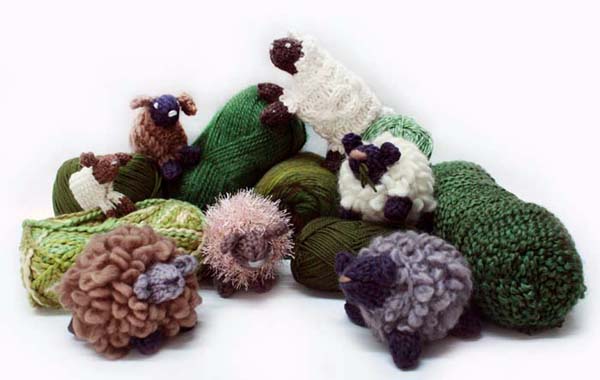
As the saying goes, “March comes in like a lion and out like a lamb.” No matter what weather you’ve been having, get ready for springtime with these adorable sheep and lamb amigurumi made with the free patterns available in the links below!

![]() |
Fluffy Little Sheep |
![]() |
Glittery Sheep |
![]() |
Cabled Sheep in Martha Stewart Crafts Alpaca Blend |
![]() |
Cabled Sheep in Martha Stewart Crafts Roving Wool |
![]() |
Sweet Seed Stitch Lamb |
Related Links:
Posted in Pattern Recommendations | 2 Comments » Comments
Today I’m going to be talking about adding the front bands to your cardi and optional closures. The cardigan in the pattern is designed to be slightly open at the front, but I decided I’d like to have a closed front, which gives me an excuse to spend hours choosing just the right buttons! There are other ways as well to close your cardi — you could use a shawl pin, or if you have some basic sewing skills, sew in a zipper.
First of all, you’ll need to pick up the stitches down the edge of your left front. I decided to do the left front first, as the right front is where the buttonholes traditionally are on women’s garments. To pick up stitches for the left front, start at the neck of the garment and work down towards the hem. When you come to pick up stitches for the right front, you will start at the hem and work to the neck. With the right side facing, put your needle between the first two stitches at the edge of your cardi, so your needle goes through the fabric from front to back. Wind your yarn around the needle, the same way you would to knit a stitch. Now you can pull the loop that you just wound around the needle back through the fabric to the front. If you find it difficult to hook the loop through with a knitting needle, try using a crochet hook. Carry on in this manner until you have the required number of stitches on the needle.
Posted in Community, Knit-Along, Knitting, Tips & How To | 23 Comments » Comments
As Jess mentioned in a post earlier this week, March is National Craft Month; to celebrate, I thought it would be fun to feature some projects that have been submitted to the Customer Gallery section on LionBrand.com. We’re so happy that you find inspiration from our patterns and/or yarns; keep submitting so we can keep sharing!
Made by: Elayne Schulman Pattern: Knit Sockies Yarn: Tweed Stripes |
Made by: Corie Ann Moon Pattern: Original Yarn: Vanna’s Choice, Vanna’s Glamour |
Made by: Joan Apple Pattern: Knit Need for Tweed Dog Sweater Yarn: Jiffy Thick n Quick |
Made by: Lois Lamphere Pattern:Knit Center Piece Treasure Yarn: Wool-Ease |
Made by: Karen Withbroe Pattern: Leisure Arts Big Book of Quick Knit Afghans Yarn: Vanna’s Choice |
Made by: Carol McIlhenny Pattern: Original Yarn: Vanna’s Choice |
Made by: Elaine Liner Pattern: Knit Cable Ready Bag Yarn: Wool-Ease Chunky |
Made by: Ellen Bloom Pattern: Original Yarn: Vanna’s Choice |
|
Thank you to everyone who’s submitted a photo to our Customer Gallery! We hope that you continue to inspire others with your craftiness all year long.
Related Links:
Posted in Community, Crocheting, Knitting | 4 Comments » Comments
When former Lion Brand Yarn Studio associate Gina Damico first told us that she was writing a young adult novel called Croak, we thought it was awesome news. But when she told us that she wanted to design an exclusive pattern inspired by the book, we were even more excited!
So what’s Croak about? It’s the story of Lex, a 16 year-old girl who is sent to live with her Uncle Mort for the summer, hoping that a few months of work on his farm will settle her wild ways. But Uncle Mort’s actually a Grim Reaper and he takes Lex under his wing. Join Lex as she explores the world of the reapers, in Gina’s debut novel.
In honor of her novel, Gina’s created an illusion scarf whose pattern you can only see at certain angles. Gina said about her inspiration:
I’ve always been a big fan of illusion knitting – it’s simple, fun, and creates an amazing effect that will impress the socks AND shoes off everyone you show it to. So when thinking about a fun accessory to create in conjunction with the release of Croak, an illusion scarf was the natural choice. Black and red stripes make for a quirky, offbeat look, and since the book is about grim reapers, the colors fit perfectly. As for the design, skulls were a must. They tie in to the plot, they offer a hint of the dark humor within, and as the saying goes, everyone loves a good skull. (I think that’s a saying. Eh, maybe not.) Thanks so much to Lion Brand for the chance to share my designs, and I hope you enjoy both the pattern and Croak!
Click here for the pattern on LionBrand.com!
Croak comes out TODAY and we’re so excited to get our hands on our own copies, so click here to learn more about it on Amazon and get one for yourself!
EDIT (10/18/12): Get the second book in the series, Scorch, now available in bookstores and online!
Posted in Knitting, Lion Staff, Yarniverse | 14 Comments » Comments
Fall and Winter are busy seasons for knitting and crochet; after all, we’d be pretty chilly without the hats, scarves, mittens, sweaters, and cowls that we make every year!

But what about crafting when it’s warm outside?
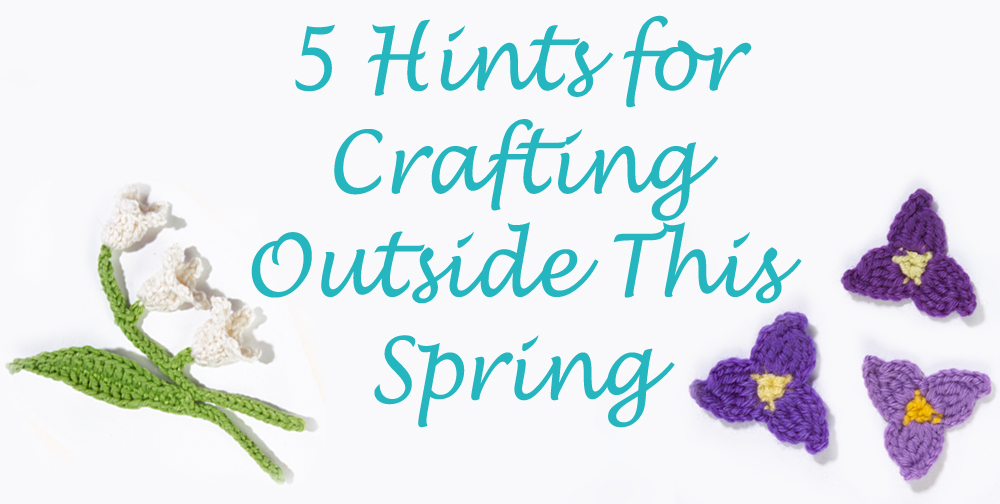
These simple tips will help you pick the patterns you’d try this spring and summer, choose the perfect yarns for your projects, inspire you with some new techniques to try and (most importantly) get you ready to enjoy the warm weather headed your way! (Want to make the flowers in this picture? Click here for the patterns from 100 Flowers to Knit & Crochet by Lesley Stanfield.)
Posted in Tips & How To | 12 Comments » Comments
Did you know that March is both National Crochet Month and National Craft Month? It’s such an exciting month, and there are so many different ways to celebrate. Our favorite way, of course, is to give back to others through teaching. If you’d like to teach a friend, relative, or complete stranger how to crochet or knit, we have many resources to support you. You can find helpful instructions, illustrations, and videos at learntocrochet.lionbrand.com and learntoknit.lionbrand.com.
We also have lots of blog posts to support your teaching. Here are some of our favorite posts.
As you’re teaching friends, remember to check out the two great sweepstakes sponsored by our friends at Knitty Daily. Click here to find out how you can win some amazing books and DVDs. I hope you celebrate the rest of the month with tons of crafting, crocheting, and knitting!
Posted in Community, Crafting, Crocheting, Did You Know . . . ?, Fiber Arts/Artists, Knitting | 1 Comment » Comments
Hi everyone! This week is going to be all about sleeves. In this pattern, the sleeves are put on hold until the body is completed. Then, the sleeve stitches are slipped back on the needle, and the ribbed border is started for short, t-shirt-length sleeves.
I decided that I’d like to do full-length sleeves. Lengthening your sleeves is pretty easy, especially if you’d like a casual looking sleeve with no shaping–just keep working until the sleeve is as long as you’d like it to be. However, I wanted more fitted looking sleeves, so I measured around my upper arm, just below my elbow and then around my wrist. Next I took vertical measurements to get the distance between those 3 points. Then, to work out how many and where my decreases should fall, I just used the same formula from my last post that I used for decreasing for the waist. For the sleeves, you’ll only be decreasing twice in each decrease row, once at each edge, rather than the four decreases across a row for the body. I placed my decreases two stitches in from the edge, to leave the edges nice and neat for seaming later on.
Posted in Did You Know . . . ?, Knit-Along, Knitting, Tips & How To | 21 Comments » Comments
Last week, I discussed directional decreases for knitting. Of course, there are also many types of increases you can use to create shaping.

Let’s go over the increases, starting with the bottom. The yarn over (yo) increase is a great decorative option that works well on either side of your work. Keep in mind that the finished stitch leaves an eyelet.
The knit in front and back (kfb) increase is also referred to as a bar increase. The completed increase appears to be your regular knit stitch on the right, plus a new purl stitch on the left. Because the new stitch is formed to the left, your original knit stitch will slant a little to the right. Despite this, the kfb is a quick, simple increase that works on either side.
For directional increases, I most often use make 1 right (m1r) and make 1 left (m1l). These variations of the make 1 increase create smooth, almost invisible increases that mirror each other very well. That’s why they’re my go-to increases.
Another option for directional increases is a lifted increase. The right lifted increases (RLI) and left lifted increase (LLI) have similar results to the make 1 increases, so they’re a great choice if you’re doing increases every few rows. However, I’d advise against them if you’re increases every right side row, as this increase can create some puckering and a noticeable line when used on every other row.
While there are other knitting increases, I find that these 4 techniques get me through most situations. Now you know how each increase looks, so when your knitting pattern calls for a vague “increase 1 stitch”, you can make your stitch selection with confidence.
Related links:
Posted in Did You Know . . . ?, Knitting, Tips & How To | Leave a comment » Comments