Lion Brand Notebook

News, Ideas and Information for Crafting with Yarn

Image frame

Turn Those Single Balls into a Spectacular Afghan

January 15th, 2013

Pin It

I’m one of those people who has a tendency of buying yarn without really knowing what to do with it. I buy one or two balls here, a skein there…

Soon, I find myself with a lot of single balls of yarn with no particular project in mind.

Of course, much of that yarn is well-used in one-skein projects. In fact, if you listen to our most recent episode of YarnCraft (the Lion Brand podcast that I co-host), you’ll get lots of ideas for great ways to use up single balls of yarn.

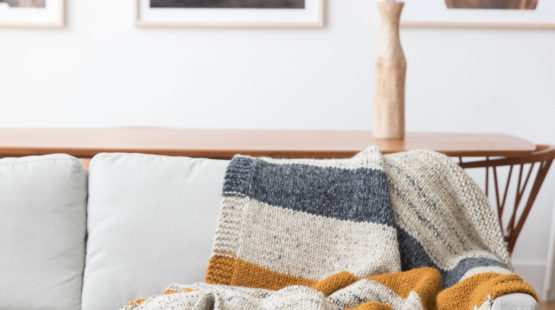
But if you’re looking to make a bigger project with all those disparate single balls, a crochet “mega granny square” afghan like our Afghan Squared pattern is an awesome way to go. Here, I’ve taken single balls of Vanna’s Choice®, Martha Stewart Crafts™ Extra Soft Wool Blend, Wool-Ease®, and Superwash Merino Cashmere and turned them into a beautiful gift for my cousin’s wedding.

Afghan Squared

Because they’re all machine-washable, worsted weight yarns, the blanket will be easy-care and non-yarncrafters won’t notice the difference in textures much.

How I designed my color scheme: While it may be feel daunting to make a variety of random colors harmonious, I found that it was best to look for colors that were similar in tone for 2-3 rows and then change to a color that provided contrast. In some areas, like the center, you’ll notice that I alternated between a single color (in this case, gray) and then one of several other colors, and then back to the first color to give it a more grounded look. I repeated the gray several more times throughout the afghan to give the color scheme some consistency. I think it turned out pretty well!

Now that I’ve taken a photo of it here in the office, I’ve put it in the mail for Jennifer and Harry to enjoy!

What have you made with single skeins or balls of yarn? Leave a comment and share your ideas!

Related links:


A Look at Wool-Ease: a Classic Worsted-Weight, Easy-Care Yarn + 9 Fan-Favorite Patterns

August 17th, 2012

Pin It

I just came back from Stitches Midwest, a knit/crochet convention put together by XRX Inc. (home of Knitter’s Magazine) – and had a great time talking with different people who love to yarncraft.   While talking to folks in our Lion Brand booth, I realized that Wool-Ease, our traditional worsted weight wool blend yarn is very popular amongst both knitters and crocheters, and for good reason!

Wool-Ease is a great garment yarn which can be machine washed and dried; making it the perfect match for children’s clothes. I personally love the stitch definition and functionality of  Wool-Ease.  Cables work up beautifully, and a scarf or hat knit/crochet in this yarn will definitely keep you warm. Below, I’ve shared some of our popular Wool-Ease patterns in sweaters, afghans and accessories.

Pullovers and Cardigans are perfect projects for Wool-Ease.  Below our Lion Brand pattern image, you’ll also find images of a submitted project from Lion Brand users who used the patterns for their garments.

Alpine Zip-Neck Pullover
Knit Alpine Zip-Neck Pullover
Ladylike Pullover
Crochet Ladylike Pullover
Cabled Women's Cardigan
Knit Cabled Women’s Cardigan
TheissAlpineZipNeckPullover 
Thanks to Susan Theiss for the submission.
Ladylike Pullover 
Thanks to Carrington Cynthea for her submission.
LindaCabledCardigan 
Thanks to Linda Keigwin for her submission.

(more…)


Squares, Flowers, Stars, and Ripples: What’s Your Favorite Pattern Motif?

July 17th, 2012

Pin It

Incorporating motifs in your pattern is a great way to play around with color work and different stitch patterns.  Motifs also are also perfect for personalizing projects- such as adding skulls to a little boys cap, or butterflies to a girl’s headband.  What fun would it be if all our clothes and home decor just came in solid colors? So – I figured I would include a round up of some of my favorite patterns with popular motifs that might make a great gift for someone you know, or even for yourself!  Below you’ll find a selection of patterns that include flowers, stars, ripples and squares.

Squares

Bauhaus Washcloth
The Bauhaus Washcloth knit by Michelle Edwards reminds me of summers spent on the beach. This sophisticated color palette, paired with a ribbed, basketweave stitch makes for an efficient, yet aesthetically pleasing set of wash/dishcloths.
Patchwork Squares Throw
Play around with color with the crochet Patchwork Squares Throw. This is a great addition for someone looking for a more modern piece for their home decor, or even for a kid’s room.
Tumbling Blocks Afghan
No this isn’t a piece of art, although you could turn it into a tapestry if you’d like – this is the Tumbling Blocks afghan knit in Vanna’s Choice. Follow the pattern chart to complete this unique, eye popping afghan

  (more…)


8 Fast & Easy Knit & Crochet Projects for Mother’s Day

May 1st, 2012

Pin It

With about two weeks left before Mother’s Day, there’s still plenty of time left to get started on your handmade gift; especially if you use a little trick – working with multiple strands.  Multiple stranding adds more texture, durability, and makes a project done in a simple stitch look great.

By knitting or crocheting with multiple yarns as one, you create a thicker fabric, speeding up the process; this technique also allows you to play with different colors at once, creating your own “tweed” look.  Click on the images below to see the different possibilities you can explore with multi-strand yarn-cafting!

(more…)


10 Adorable Knit and Crochet Baby Patterns for Spring

April 18th, 2012

Pin It

I’m almost positive that this spring of 2012 is baby season.  I personally know a few people who are currently pregnant and a few who just had babies, so I thought I’d share some patterns to get you thinking about yarn-crafting a special hand-made gift for a special little person you may know (or who’s on the way!).

I’ve included knit and crochet patterns made with yarns that are most suitable for warmer weather, from super soft cottons like Nature’s Choice Organic and Baby’s First— to the brightly colored, and easy care of Vanna’s Choice Baby.

(pattern in image: Soft and Sweet Baby Blocks)


Sunshine Day Baby Throw
(Knit) Sunshine Day
Baby Throw in
Vanna’s Choice Baby &
Cotton-Ease

(Knit) Baby Booties in
Nature’s Choice Organic
Cotton

(Click here for hat pattern)
Baby Hat with Flower
(Crochet) Baby Hat
with Flower in Vanna’s
Choice Baby

(Crochet) Baby Blocks
Throw in Babysoft

(more…)


Get Inspired by Amazing Afghan Patterns

December 21st, 2011

Pin It

How will you be keeping warm this winter?  Will you be cozy by the fireside?  Will you be wrapped up in your afghan on the couch?  Afghans and lapghans are a great way to stay warm and snuggly at home or in the car. While you’re relaxing with your lapghan/afghan, you might as well think about a pattern for your next one! Listed below are a few pattern suggestions along with some afghans that have been submitted to our customer gallery; check it out it see if you’ve been featured.

Miss Yvette's Afghan
Miss Yvette’s Sampler Throw
Crochet
Homespun

Circles to Squares Afghan
Crochet
Vanna’s Choice
Updated Ripple Afghan
Updated Ripple
Afghan

Knit
Vanna’s Choice
Slip Stitch Sampler Throw

Knit
Vanna’s Choice


Customer Gallery Submissions

Wool Ease Customer Submitted Afghan
The Afghan Squared by Donna
Crochet in Wool-Ease
Click here for pattern
USA afghan
US Afghan by Cheryl Kissee
Knit in Wool-Ease
Click here for pattern

Circle in a Square Afghan
by Nichole Rivers
Crochet in Homespun
Click here
for pattern
Walk of Fame Afghan
Walk of Fame Star Afghan
by B. Palkki
Crochet in Homespun
Click here for pattern

It’s always exciting to see the great pieces you’ve created with our yarns and we encourage you to continue submitting. Please also include whether the pattern is your original or a Lion Brand pattern, that information is helpful to others who may be inspired by your work. Keep yarncrafting and stay safe and warm this season!


What Is Fingering/Sock/Sport/DK/Worsted…Weight Yarn?

July 31st, 2011

Pin It

Yarn weights go by so many different names, it can be difficult to keep track of what’s what! (For example, did you know that Fingering weight and Sock weight are one and the same?)

To help you out, we’ve compiled a chart using the yarn weight standards developed by the Craft Yarn Council, along with examples of Lion Brand Yarn in each category.

Yarn Weight Symbol/Category Name Commonly Used Names Example of Lion Brand Yarn
Cobweb, Lace, Crochet Thread
LB Collection® Wool Stainless Steel *
Sock, Fingering, Baby
LB Collection® Silk Mohair
Sport, Baby
Vanna’s Glamour™
DK, Light Worsted
LB Collection® Cotton Bamboo
Worsted, Afghan, Aran
Wool-Ease®
Chunky, Craft, Rug
Wool-Ease® Chunky
Bulky, Roving
Wool-Ease® Thick & Quick®

* Note: Although LB Collection® Wool Stainless Steel is listed on our website as a Category 1 Super Fine yarn, it may be used as a Category 0 yarn.

Interested in learning more about which of our yarns are in which weight category? Click here to check out our list of yarns by weight class on LionBrand.com.

Related Links:


Exploring Stitch Patterns & Techniques

October 17th, 2010

Pin It

The Lion Brand Yarn Studio is collecting 7″ x 9″ afghan blocks for Warm Up America.  Our customers are amazingly generous and we have collected over 200 so far!

One thing I love about making small projects is the chance to experiment with stitch patterns.  We’ve had some great knit blocks turned in from customers that used our stitch finder for inspiration.  We’ve seen Basketweave, Moss Stitch, Sugar Cubes and more.

Here are a few crochet blocks from our window that customers have turned in, that looked fun.  Our own Studio crochet expert, Gina, took a look to see how they made their squares–see below to make your own afghan blocks in these patterns.

Dark Blue – front post/back post pattern

Ch 25
Row 1: sc across, turn
Row 2: Ch 3, 2 dc, *fpdc, 2 dc, repeat from * to end, turn
Row 3: Ch 3, 2dc, *bpdc, 2dc, repeat from * to end, turn

Repeat last two rows until piece measures 9”. Fasten off and weave in ends.

Green – basic shell stitch pattern

Ch 25
Row 1: Sc across, turn
Row 2: Ch 1, sc, (5 dc in next sc, skip 1, sc, sk 1) repeat ( ) 3 times, end with sc, turn
Row 3: Ch 3, 2 dc in same sc, (sc in 3rd dc of previous shell, 5 dc in next sc), repeat ( ) 3 times, end with sc in 3rd dc, 3 dc in last sc

Repeat last two rows until piece measures 9”. Fasten off and weave in ends.

Light Blue – easy textured pattern

Ch 23
Row 1: Sc across, turn
Row 2: Ch 3, *dc, sc, repeat from * to the end
Row 3: Ch 1, *sc, dc, repeat from * to the end

Repeat last two rows until piece measures 9” tall. Fasten off and weave in ends.

In the NYC area? Join our collection and stop by the Studio to drop off your blocks; learn more by clicking here. If you’re not in the NYC area and would still like to donate, please click here to visit Warm Up America! Foundation’s website and send your blocks directly to the organization.

What stitches do you like to experiment with? Leave a comment and tell us!


Motif Afghan Crochet-Along: Welcome!

September 17th, 2009

Pin It

Hello, Crocheters!

My name is Edie Eckman, and I’m so excited to be leading this Motif Afghan Crochet-Along! I’m a crochet (and knit) designer, and lately I’ve been doing lots of motif crochet. You may think of it as “granny squares”, but I’ve found it can be so much more than that.

Let me tell you what I have in mind for this adventure.

We’ll be making a full-sized motif-based afghan in 3 or 4 colors. I’ve chosen Motif #48 from my book Beyond the Square Crochet Motifs as the basis for the design. It works well in 1, 2, 3 or 4 colors, and the hexagonal shape is so versatile that we have plenty of opportunity for creativity. You can find the motif instructions here.

This week, we’ll be choosing colorways. The following week, we’ll look at how the motif appears when stitched in a variety of color combinations and learn the “sliding loop” method of beginning a motif in the round. In Week 3, I’ll show you a couple of ways to envision the final design, so you can decide how many motifs to make. The next week will include tips for improving your technique, dealing with yarn tails, and joining as you go. The final week we’ll finish up: block, sew together (if we didn’t join them as we worked), and weave in the ends.

Of course, this is simply a suggested outline. As we progress, I’ll answer questions, and let you help me decide what we need to discuss. As in life, the plan is subject to change.

Choosing Colors

One of my favorite things about starting an afghan project is choosing the yarn. There are so many possible choices! I decided early on that I’d be using Lion Brand’s Vanna’s Choice and/or Vanna’s Choice Baby, because of the many beautiful colors that are designed to go together. Wool-Ease is another good choice.

Although I didn’t have any particular colorway in mind, I was looking for three or four colors that would look good together. I really find it hard to make up my mind when it comes to colors, so I’m starting with a bunch of choices. I like bright colors, but sometimes for home decor I’d prefer something more subtle. I’ve narrowed down my choices to four colorways, and wound some yarn onto white index cards to get an idea of how they might look together, and in what proportions.

Colorway #1

Colorway #1

Colorway #2

Colorway #2

I like #1 and #2 for a baby or kid’s afghan, but I don’t have any (little) kids at my house.

Colorway #3

Colorway #3

#3 would look great in my bedroom, but I recently did another afghan in a similar colorway and I’m afraid I might get tired of it.

Colorway #4

Colorway #4

#4 would work well in my den.

I’m leaning strongly toward #3 or #4.

What do you think? Let me know which colors you want to see me use in the comments section! You have FIVE days to help me decide, because I have to get the yarn!

Now…you go choose some yarns that will work for you. Since motifs lend themselves to using up colorful scraps of yarn, you could just go crazy and use a wide variety of colors! However, even if you are using up yarn from your stash, it’s a good idea to choose colors deliberately.

Also, leave a note and introduce yourself! We want to know what yarn and colors you want to use, and we want to know a little about you!

Let the adventure begin…

Related links:


Crochet-Along: Stepping through Block 1 and Block 3

September 24th, 2008

Pin It

I hear some of you are finished already! I myself am woefully behind the pack, looking forward to a week of non-stop crocheting! Here’s a little step through of Blocks 1 and 3 to help address some of your comments.

Block 1 : Sc-tbl Stitch
Ch 27.
Row 1 Sc in 2nd ch from hook and each ch across – 26 sc.
Row 2 Ch 1, turn. Sc in back loop only of each st across.
Rep (Row 2) 31 times more. Fasten off.

That Sc-tbl, means work single crochet stitches through the back loop. After you’ve worked your first row of single crochet into your foundation chain, take a look at what you’ve just crocheted. The top of each stitch has 2 loops. We usually work through both. “Through the back loop” means work only through the back loop (the loop furthest from you). Mama Mac, my great grandmother, called this the back porch and the front loop the front porch. This one simple difference of working through one loop opens up a whole different drape and texture for your fabric. It’s one of my absolute favorite ways to add a subtle dash of spice to some simple crochet.

If you work through only the back loop every row, there will be alternating ridges on each side of your work. These ridges are created by the un-worked front loop. Also, working through only one loop loosens up the drape a bit, you’ll notice that back loop gets stretched out a bit and there will be more space between your rows.

If you were to work through only the front loop every row, you’ll find the same result you get with the back loop. If you work through front loop only the one row and back loop only the next, you’ll see that the ridges will all be on one side.

Here’s a very simple change if you want to try another something different: Alternate across a row, working through the front loop of one stitch and the back loop of the next stitch. This creates a subtle waffled sort of texture.

Ch 27.
Row 1 Hdc in 2nd ch from hook and each ch across – 26 hdc.
Row 2 Ch 1, turn. hdc in back loop only of next st, hdc in front loop only of next stitch, repeat across the row.
Repeat Row 2 to the desired size.

Block 3: Cluster Stitch

Ch 26.
Row 1 (RS) Sc in 2nd ch from hook and each ch across – 25 sc.
Row 2 Ch 2, turn (counts as first dc), CL in next sc; *ch 1, skip 1 sc, CL in next sc; rep from * to last dc, dc in last sc.
Row 3 Ch 1, turn. Sc in first dc and in each CL and ch1-space across to t-ch; sc in top of t-ch. Rep (Rows 2 and 3) 8 times more. Fasten off.

Let’s step through Rows 2 and 3:
Row 2 starts with a ch 2 turning chain that will stand in as a double crochet, next you will work your first cluster stitch in the second single crochet from the previous row. This is very important, don’t work the cluster in the first stitch of the row, but the next one (the second stitch of the row.) Chain 1, skip the next stitch (third stitch of the row) and work the next cluster into the fourth stitch of the row. Continue in this combination across the row: chain 1, skip a stitch, cluster in next stitch. If you have an odd number of stitches in your first row of sc this will work out such that you have clusters along the row with a double crochet in the first (remember that turning chain is pretending to be a double crochet) and last stitch of the row. If you adjust your number of stitches in a row to get your blocks the same size make sure to use an odd number of stitches with this one!

For Row 3, work a single crochet in that double crochet from the previous row, then single crochet in the top of the cluster stitch and single crochet into the chain stitch and keep going across the row. Work a single crochet into that turning chain from the beginning of the last row and your sc row is finished! You should have the same number of stitches in Row 3 as you did in Row 1. See the photo for a close up of the single crochet worked into the cluster row.

Little mistakes to look out for:
-Don’t work the first cluster of the row in the first stitch!
-Don’t work a chain between the last cluster of the row and the last double crochet. This will throw off your stitch count. I have to keep an eye on myself because I keep doing this!

Happy Crocheting!

Related posts: